
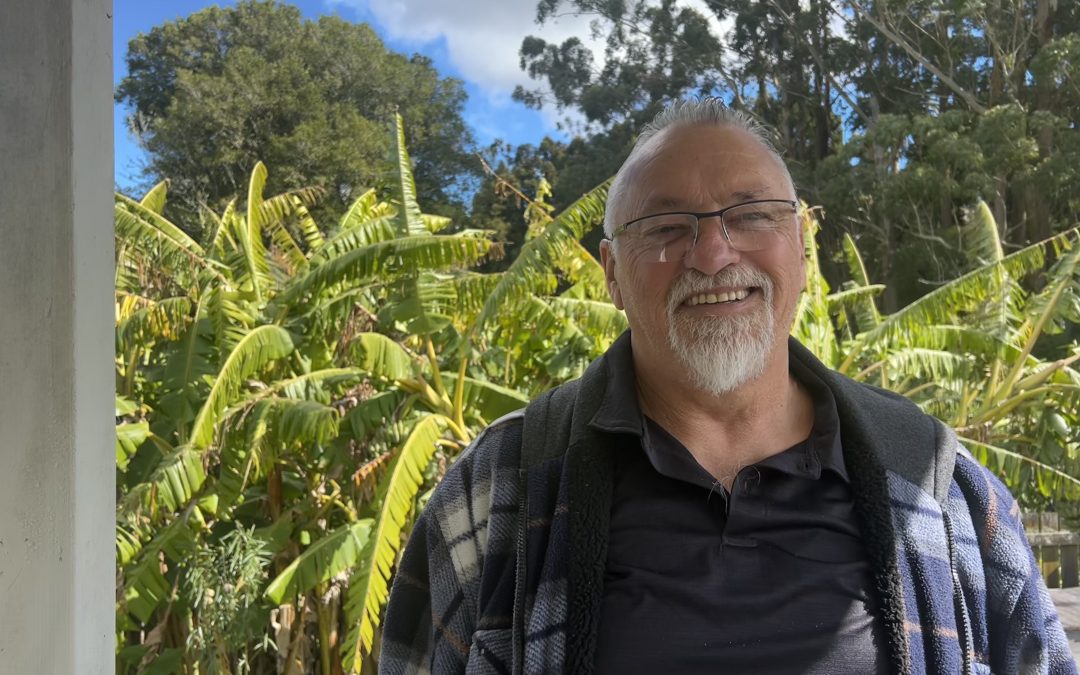
My journey into social services started after I had an accident at work in my twenties. I was off for six months with a wrist injury, and I thought, well, I may as well learn to push the pen. I enrolled to study counselling and social services at Te Whiuwhiu o Hau, through Wintec. ACC supported me in the first year, then I lived on student allowance and part-time work in the second year.
One of my study placements was at Man Alive, helping men with anger management. I loved it. I learned the admin, became a facilitator, and ran groups. My other placement was at Te Whare Ruruhau o Meri in Auckland. That was the beginning of it all. From there, my first job was at Waipareira Trust as an addictions counsellor. My end goal was always to get my tohu and move up North to support whānau. I whakapapa to Ngawha, and I wanted to come home. My brother said, ‘Come work at the prison with me,’ but that was his path, not mine, and he was awesome at what he did. I looked around and got a job at OT in Kaitaia, facilitating family hui. Not long after, I was recruited by the DHB into youth mental health and addictions at Te Roopu Kimiora. I worked there for ten years with rangatahi struggling with suicidal ideation, self-harm, and addiction.
At one stage, I had 54 people on my caseload & I completely burnt out. My doctor told me to leave the job, so I went on the sickness benefit for six months to recover. Later, I started at Salvation Army Bridge as a Pou Whānau Connector in meth harm reduction. I worked there for five years until I took early retirement a month ago. I get my pension in ten days’ time and I definitely feel ready to retire. I’ve worked or studied my entire life, and I’m ready for doing the things I want to do… like putting the new shocks on my truck that I bought 6 weeks ago!
One of the biggest things that stood out to me working in child and adolescent mental health, was how different it was from adult services.
With adults, it was often assess the client, prescribe medication, and send them on their way. With rangatahi, we made sure all their spaces were safe — school, home, family — so they felt comfortable enough to reach out. You can give an adolescent six sessions of CBT and that equips them with tools for life. Adults are too often left with just medication. That’s why so many working in mental health burn out. The government doesn’t put enough into our health system, especially mental health. It’s always a band aid solution, never a holistic healing approach.
Support for the workers in mental health makes or breaks the job. At Waipareira we were given gym and swimming memberships to destress, even if we had to do that during work hours. At Te Roopu Kimiora, I had a boss with a big heart who supported us really well. That kind of awhi in those working environments keeps people going.
Over my career I’ve seen the power of listening. Often, people already hold the answers — they just need guidance. Too many are pushed through a system that ticks boxes and puts plasters on problems.
I helped bring the Man Alive programme up here to the Far North and we ran it for three years. I eventually had to step out of it as I had taken my brother’s mokopuna into my care at ages 2 and 4, so alongside that and my full-time job, something had to give. The programme was about teaching men about the seven forms of abuse. That programme not only changed lives, it changed mine. When I first did the Man Alive programme as a student, I realised that although I never hit my kids, my words were abusive. My language hurt them. The night I had that revelation, I apologised to my children who were 16 and 18 at the time. They said “No Dad, you haven’t abused us”, but I wanted them to understand the ways that I had and that it wasn’t okay. From that moment, my relationship with them changed completely.
People sometimes say I’m gentle, or I let people walk over me. It’s not that — I still get frustrated, but I’ve learned anger doesn’t help any situation. People have a right to say what they want; I have a right to put up a boundary and walk away. Everyone has that right. I taught my clients the same. I’d ask them ‘Is it something you can control?’, if the answer was no, then walk away. Sometimes even just taking a 15-minute break can stop a conflict from blowing up. Those tools, and things like Cognitive Behavioural Therapy, should be taught in schools from Year 7 — I think it would transform our mental health system.
I see myself as the lone pou in my whānau sometimes — both my brothers have passed, one in 2014 and one in 2023, although my three sisters are still here, young and grey. I had a bit of a mental battle when my brothers passed away because I thought I’d die before 50, but I’m 65 now, still here and they’re not sadly. I keep them close to my heart and my mind and know that I’ll see them again one day. Someone once told me a few years ago that I’ll live to 104, so that’s what I’m going to do. My wife jokes that she’ll be there to change my nappies.
When my brother Paul died of a heart attack in 2014, I had my own heart attack two months later. I felt this heavy pressure on my chest one morning when I got to work, so I went to the hospital to get it checked out; next thing I was flown to Auckland for a stent. Every two years I have go back for testing. Those moments remind you how precious life is.
Now that I’ve retired, I’m finding lots to keep me busy – home projects, whānau, marae visits. Part of my retirement plan is to spend more time at the marae and immerse myself in te reo. I’ve studied bits for years, but it’s never really stuck. I see myself as 100% Māori, but I still don’t feel complete without the reo. That’s something I want to focus on now. I’m grateful for my career, for the people I’ve walked alongside, and for the lessons I’ve learned. I’ve learned everything always comes back to whānau & caring for each other. Most people just need somebody to listen to them.”